This project was built under real constraints - limited time, limited tooling access. In this final article, I cover how I’d improve it given neither.
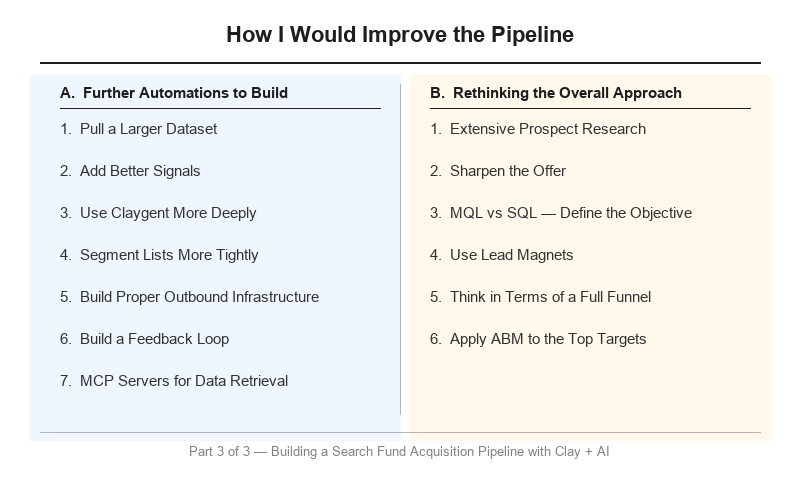
There are two types of improvements worth discussing:
Further automations to build
Rethinking the overall approach
A. FURTHER AUTOMATIONS TO BUILD
1. Pull a Larger Dataset
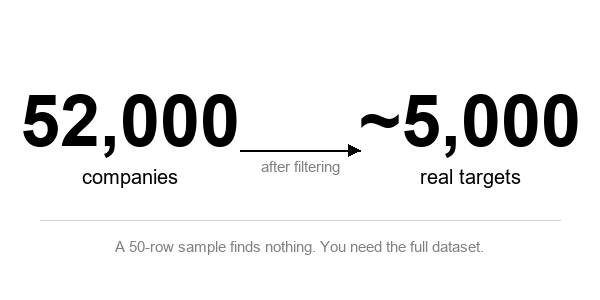
52,000 companies sounds like a lot. After filtering, the real target universe is ~5,000. But you can’t find the “needle"“ without pulling the “full haystack” - the 50-row free tier sample isn’t sufficient to build the real pipeline.
2. Add Better Signals
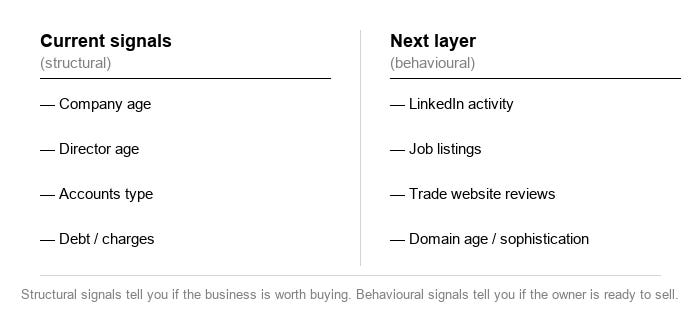
The current signals used are good - company age, director age, accounts type, debt. The next layer would to layer behavioural data to enrich the “officer” data:
Director LinkedIn activity - posting about retirement, business challenges, or growth fatigue
Job listings - hiring a manager for the first time suggests the owner is trying to step back
Trade website reviews - volume and recency as a proxy for revenue activity
Domain age and website sophistication - a site built in 2009 and never updated is a strong unsophisticated-seller signal
These are useful spreadsheets (not mine) which gives signal ideas:
https://docs.google.com/spreadsheets/d/1Y3bbNPJ5tmOk2wlQO7ItWz3wzjM4tglPjlz6vnAqmwA/edit?gid=0#gid=0
https://airtable.com/appGc0v7TfWslJP7L/shrX0gSEGYdasEu58/tblBOqYAGCSL9bVRC
3. Use Claygent More Deeply
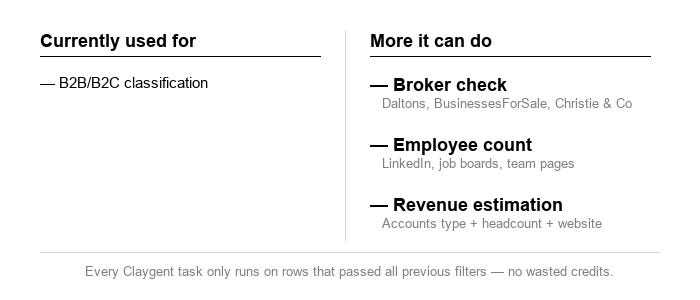
I used Claygent for B2B/B2C classification. There’s more it can do:
Broker check - search Daltons, BusinessesForSale.com, and Christie & Co for any active listing
Employee count estimation - triangulate from LinkedIn, job boards, and website team pages
Revenue estimation - combine accounts type, website sophistication, and headcount signals
4. Segment Lists More Tightly
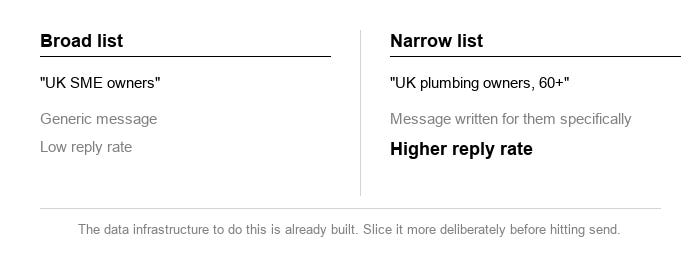
The best-performing outreach campaigns have gotten more specific over time. A message written for “UK plumbing company owners aged 60+” will always outperform one written for “UK SME owners.” Tighter segmentation produces better message-to-market fit — and better message-to-market fit is what drives reply rates.
The data infrastructure to do this is already built. It’s just a matter of slicing it more deliberately before hitting send.
5. Build Proper Outbound Infrastructure
None of this works without a properly configured sending environment.
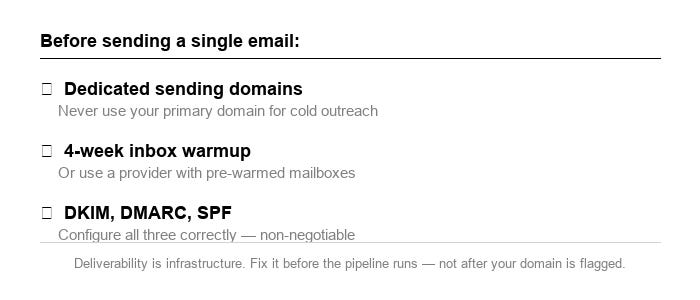
Buy dedicated domains for cold outreach. Warm the inboxes for at least four weeks before sending. Configure DKIM, DMARC, and SPF records correctly. Deliverability is all about the infrastructure.
Multiple providers now offer pre-warmed mailboxes, which removes the warmup period entirely.
6. Build a Feedback Loop
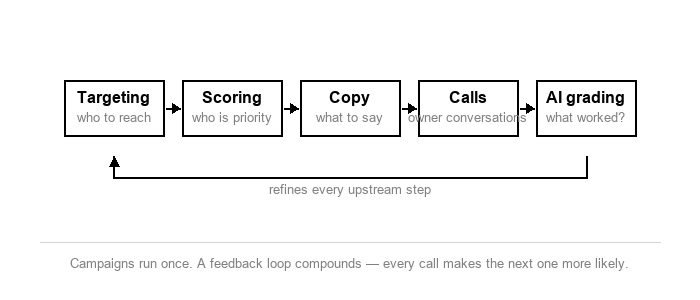
Everything above is a system that runs once and produces output. The next level is a system that learns.
Once one is getting calls with business owners, the next step would be to introduce an AI layer that grades each conversation - which framing generated engagement, which questions triggered openness about exit, which objections came up repeatedly. That analysis feeds back into every upstream step. Better call data refines the copy. Better copy refines the scoring. Better scoring refines the targeting.
This is the difference between a campaign and a machine that compounds over time.
7. MCP Servers for Data Retrieval
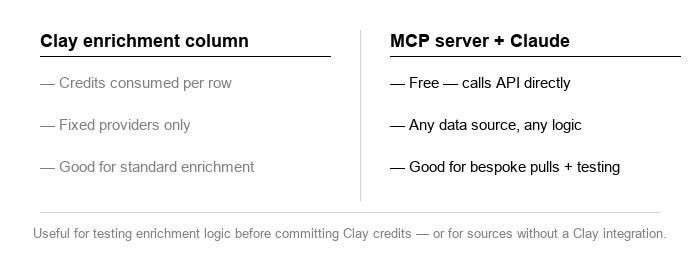
One underexplored option: Model Context Protocol (MCP) servers as an alternative to Clay enrichment columns for certain data pulls.
An MCP server connected to Claude can call the Companies House API directly, run enrichment logic, and return structured data - all within a single conversation context. For bespoke data pulls or testing enrichment logic before committing Clay credits, it’s a faster and cheaper path.
B. RETHINKING THE OVERALL APPROACH
1. Extensive Prospect Research
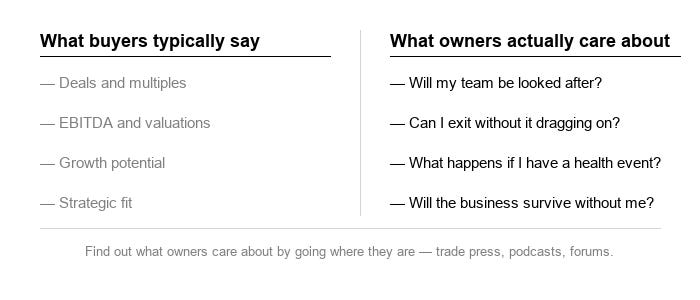
Dan Kennedy made an observation: people don’t buy what you sell, they buy a solution to a problem they feel acutely.
The acquisition equivalent: don’t approach a business owner talking about deals and multiples. Approach them talking about the problem they’re sitting with.
What are the actual concerns of a 62-year-old plumbing company owner? To better understand “pain points”, one should go to where these owners are. Trade magazines, podcasts forums etc. This is market research.
2. Sharpen the Offer
The pipeline finds the right companies. But what am I actually offering?
“I want to buy your business” is one offer, but it might not be the most compelling. The message needs to communicate a specific value proposition.
For example:
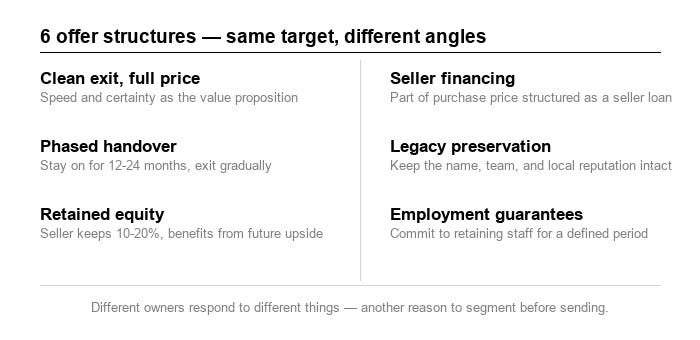
Clean exit, full price - Speed and certainty as the value proposition.
Phased handover - Reduces the psychological barrier of walking away from something they built.
Retained equity - Works well when the owner believes in the business but is tired of running it.
Seller financing - structure part of the purchase price as a loan from the seller.
Legacy preservation - keep the company name, keep the team, keep the local reputation intact.
Employment guarantees - commit to retaining staff for a defined period. Often the thing an owner cares most about and the thing buyers never mention.
The offer determines reply rate as much as the targeting does. Different owners respond to different things - which is another argument for segmenting the list before sending.
3. MQL vs SQL - Defining the Objective
A reply isn’t a deal. But it might be sufficient - at least at first.
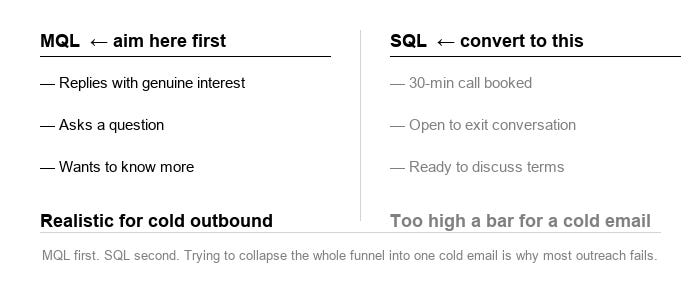
Most outbound campaigns are implicitly optimised for SQLs - getting a business owner on a call, ready to discuss an exit. That’s a high bar for a cold email. These are people who have never considered selling, have never met you, and are being asked to entertain one of the biggest decisions of their lives off the back of a single message.
An MQL - someone who replies with genuine interest, asks a question, wants to know more - is a more realistic first objective for cold outbound.
The job of the outreach sequence is to generate that initial signal of interest. The job of everything that follows - the follow-up, the education, the offer framing, the calls - is to convert that interest into a real conversation. Trying to collapse the whole funnel into a single cold email is why most acquisition outreach doesn’t work.
MQL first. SQL second.
4. Use Lead Magnets
Cold outreach asks for something. A lead magnet gives something first.
Done well, it builds a warm list of owners who’ve already engaged with relevant content - and signals credibility before any direct approach. AI makes this easy to produce:
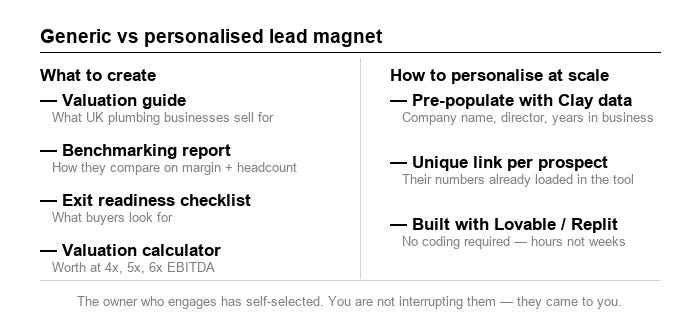
A valuation guide - what UK plumbing businesses sell for and at what multiples. The owner who downloads this is already thinking about exit.
A benchmarking report - how their business compares on margin and revenue per employee. Business owners are competitive. They want to know where they stand.
An exit readiness checklist - what buyers look for, what makes a business hard to sell. Frames you as the expert before you’ve spoken.
A valuation calculator - estimate what a business is worth at 4x, 5x, or 6x EBITDA. Interactive beats PDF every time.
Tools like Lovable and Replit let you build and deploy personalised software and landing pages at scale.
Instead of sending every prospect the same guide, you generate a personalised version for each company, pre-populated with their data from Clay. Or build a hosted tool and send each prospect a unique link with their business already loaded. They click and see their own numbers.
The owner who engages with your content has self-selected.
5. Think in Terms of a Full Funnel
Email opens the conversation.
Thinking in terms of the full funnel changes what you build:
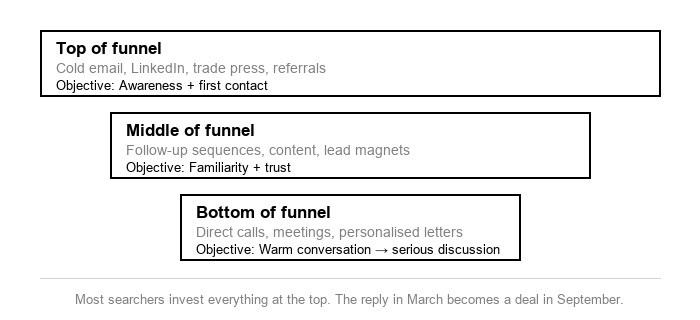
Top of funnel - cold email, LinkedIn content, trade press, referrals. Objective: awareness and first contact.
Middle of funnel - follow-up sequences, educational content, lead magnets. Objective: familiarity and trust with owners who’ve engaged but aren’t ready to sell yet.
Bottom of funnel - direct calls, in-person meetings, personalised letters. Objective: converting a warm conversation into a serious discussion.
Most searchers invest everything at the top and have nothing for the middle or bottom. The owner who replies in March might be ready to talk seriously in September - but only if there’s been consistent, credible contact in the interim. The pipeline should manage the relationship until the owner is ready, not just generate first touches.
6. Apply ABM Principles to the Top Targets
ABM was designed for enterprise B2B sales. The principle translates directly to acquisition outreach.
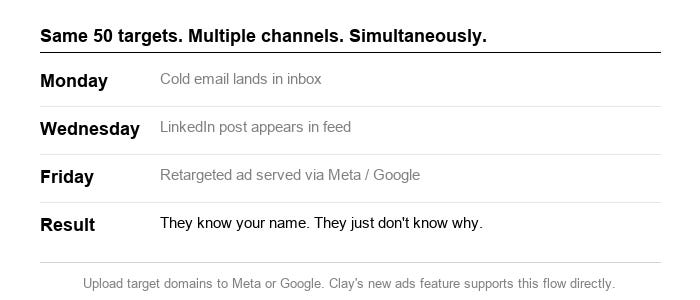
The idea: identify your highest-priority targets and treat them as markets of one. Instead of sending everyone the same sequence, coordinate multiple touchpoints across multiple channels - email, phone, direct mail, advertising - all pointed at the same 50 companies simultaneously.
Retargeting ads are particularly underused here. Upload your target company domains to Meta or Google and serve ads specifically to people browsing from those organisations. The owner who received a cold email on Monday, can see a LinkedIn post on Wednesday, and then an ad on Friday.
Clay has launched a new “ads” feature to support the above flow.